


Overview
Research and measurement drive our understanding of how Food Is Medicine interventions influence health, nutrition, healthcare utilization, and quality of life. As Food Is Medicine programs continue to expand across healthcare and community settings, consistent measurement and rigorous evaluation can help identify effective approaches, inform policy and payment decisions, and support implementation within all communities and population groups.
This section highlights the current evidence, introduces tools and frameworks for evaluation, and provides resources to support researchers, healthcare organizations, community-based organizations, policymakers, and others working to advance Food Is Medicine.
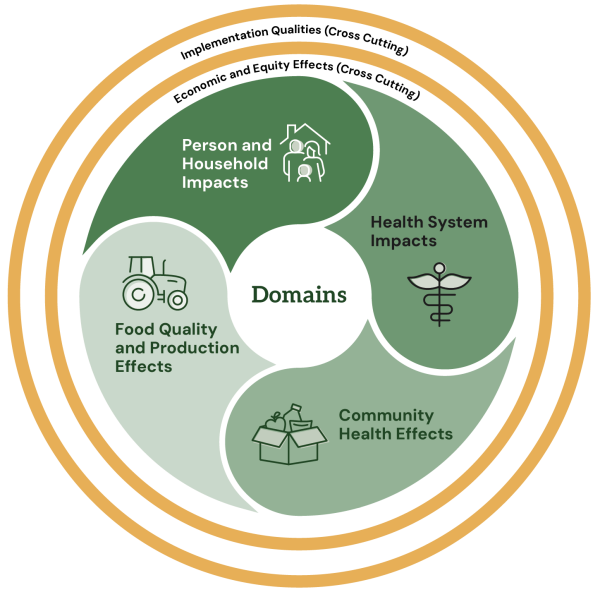
- Person and Household Impact
- Health System Impacts
- Community Health and Food Access Effects
- Food Quality and Production Effects
- Cross-Cutting Measurement Catagories
Evidence and Research
A growing body of research suggests that Food Is Medicine interventions can improve food security, dietary quality, disease management, and health outcomes for individuals at nutritional risk. Studies have also explored impacts on healthcare utilization, including hospitalizations, emergency department visits, and healthcare spending.
Key areas of research include:
- Nutrition outcomes
- Chronic disease prevention and management
- Healthcare utilization and costs
- Health equity and access
- Older adult nutrition and healthy aging
- Program implementation and sustainability
Food Is Medicine Analytic Framework
The HHS Food Is Medicine Analytic Framework provides a common approach for evaluating Food Is Medicine interventions across a variety of populations and settings. The framework supports consistent measurement while recognizing the wide range of intervention models and desired outcomes.
The framework can help to:
- Identify meaningful outcomes and indicators
- Select appropriate measures and data sources
- Compare findings across programs and settings
- Support continuous learning and improvement
Measurement and Evaluation Resources
High-quality measurement is essential for understanding the effectiveness, implementation, and impact of Food Is Medicine interventions. The HHS Food Is Medicine Analytic Framework identifies 4 primary measurement domains and 2 cross-cutting measurement categories that can help organizations assess outcomes, strengthen implementation, and inform future investments.
Person and Household Impacts
This domain assesses the effects of Food Is Medicine interventions on participants and their households, including access to nutritious foods, nutrition-related behaviors, and health outcomes.
Common measures may include:
- Participation in Food Is Medicine interventions
- Food security status
- Access to healthy and culturally appropriate foods
- Dietary quality and healthy eating behaviors
- Fruit and vegetable consumption
- Nutrition risk and malnutrition measures
- Clinical indicators (e.g., HbA1c, blood pressure)
- Functional status
- Quality of life
- Patient-reported health outcomes
Health System Impacts
This domain assesses how healthcare organizations, providers, and community partners work together to deliver Food Is Medicine services and improve health system performance.
Common measures may include:
- Availability of Food Is Medicine services
- Referrals to Food Is Medicine programs
- Food and nutrition screening rates
- Integration of nutrition screening into clinical workflows
- Integration of community-based organizations into care delivery
- Provider engagement and satisfaction
- Patient enrollment and retention
- Healthcare utilization and total cost of care
- Emergency department visits
- Hospital admissions and readmissions
Community Health and Food Access Effects
This domain assesses how Food Is Medicine interventions influence community health, food access, and community systems.
Common measures may include:
- Community food security
- Access to healthy and culturally appropriate foods
- Food affordability and availability
- Health-related social needs prevalence
- Population nutrition literacy
- Social connection and social isolation
- Diet-related disease prevalence
- Community network capacity
- Community economic benefits
- Access to community-valued nutrition interventions
Agri-food Quality and Production Effects
This domain assesses the relationship between Food Is Medicine interventions, food systems, agricultural production, and regional food economies.
Common measures may include:
- Procurement of locally or regionally produced foods
- Support for local and regional food producers
- Healthy regional food purchasing
- Strengthening local food economies
- Food system transformation and expansion
- Agricultural sustainability and resilience
Cross-Cutting Measurement Categories
Across all 4 domains, the framework also encourages consideration of:
Economic Effects
Measures that assess financial impacts on participants, healthcare systems, communities, and food systems.
Examples include:
- Total cost of care
- Healthcare expenditures
- Return on investment
- Community economic impact
- Food system economic benefits
Program Implementation Qualities and Characteristics
Measures that assess how Food Is Medicine interventions are delivered, adopted, and sustained.
Examples include:
- Reach and access
- Participation and retention
- Referral completion rates
- Time from referral to service receipt
- Intervention adherence
- Program fidelity
- Cultural responsiveness
- Partnership effectiveness
- Workforce capacity
- Sustainable funding mechanisms
Commonly Used Research and Measurement Resources
The resources below are external to HHS and are provided for informational purposes only. Inclusion does not imply endorsement by HHS or the U.S. Government.
Research and Evidence
Food Is Medicine Research Action Plan
A roadmap outlining research priorities, evidence gaps, and opportunities to strengthen the Food Is Medicine evidence base.
Food Is Medicine Research Database
Curated collection of peer-reviewed studies and evidence related to Food Is Medicine interventions.
Tufts Food Is Medicine Institute
Research, policy analysis, and evidence generation focused on Food Is Medicine interventions and health outcomes.
Measurement and Evaluation
Academy of Nutrition and Dietetics Evidence Analysis Library
Evidence reviews and practice resources related to nutrition interventions for chronic disease prevention and management.
Behavioral Risk Factor Surveillance System (BRFSS)
The nation's largest ongoing health survey, including measures related to chronic disease, health behaviors, preventive services, and quality of life.
CDC Chronic Disease Indicators (CDI)
A standardized set of chronic disease measures used by states and public health organizations to track disease burden and related risk factors.
CDC Diabetes Prevention Impact Toolkit
Provides tools and calculators to estimate health and economic impacts of diabetes prevention and management interventions.
Provides model-based local estimates for chronic disease prevalence, health outcomes, and health-related behaviors that can support community-level Food Is Medicine evaluation.
Screening tool to identify patient needs in 5 different domains that can be addressed through community services (housing instability, food insecurity, transportation difficulties, utility assistance needs, and interpersonal safety).
A validated measure of dietary quality that assesses alignment with the Dietary Guidelines for Americans and is commonly used in Food Is Medicine evaluations.
Malnutrition Quality Improvement Initiative (MQii)
Tools, quality measures, and implementation resources for identifying and addressing malnutrition in clinical settings.
National Health and Nutrition Examination Survey (NHANES)
National survey and measurement resources that provide standardized nutrition, dietary intake, biomarker, and chronic disease measures used extensively in research and evaluation.
National Institute on Aging: Nutrition and Healthy Aging
Research and resources related to nutrition, healthy aging, and older adult health outcomes.
PRAPARE® (Protocol for Responding to and Assessing Patients' Assets, Risks, and Experiences)
A widely used screening and assessment tool for social drivers of health, including food insecurity and related risk factors.
PROMIS® (Patient-Reported Outcomes Measurement Information System)
Validated tools for measuring physical health, mental health, social well-being, and quality of life outcomes relevant to Food Is Medicine interventions.
USDA Household Food Security Survey Module
Widely used tool for measuring food security status among households.
The Food Is Medicine evidence base continues to evolve. Future research will help strengthen understanding of which interventions are most effective, how they can be scaled sustainably, and how they can improve health outcomes across populations and communities and throughout the lifespan, from young children to older adults.
Continued collaboration among researchers, healthcare providers, community organizations, payers, and policymakers will be essential to advancing evidence-informed Food Is Medicine strategies nationwide.
