Health Conditions
Eat Healthy
The Basics
Overview
Eating healthy means following a healthy eating pattern that includes a variety of nutritious foods and drinks. It also means getting the number of calories that’s right for you (not eating too much or too little).
Eat real food.
Prioritize a diet built on whole, nutrient-dense foods. Choose a variety of healthy foods from these food groups:
- Protein foods — like eggs, poultry, seafood, and meat from animal sources, and plant-based sources like beans, peas, lentils, legumes, nuts, seeds, and soy
- Dairy — like milk, yogurt, cheese, and, depending on your dietary needs, lactose-free or lactose-reduced products and fortified dairy alternatives, such as soy, almond, or oat milk yogurt
- Vegetables — like broccoli, carrots, spinach, peppers, sweet potatoes, beets, okra, and jicama
- Fruits — like berries, apples, oranges, bananas, grapes, and mangos
- Healthy fats — found in many whole foods like salmon, sardines, nuts, seeds, avocados, olive oil, eggs, dairy, meat, and poultry
- Whole grains — like brown rice, whole-wheat bread, oatmeal, and whole-grain pasta
Limit certain nutrients and ingredients.
Sodium (salt)
Sodium is found in table salt — but most of the sodium we eat comes from highly processed, packaged food or food that’s prepared in restaurants.
Added sugars
Added sugars include syrups and sweeteners that manufacturers add to products like sodas, yogurt, and cereals — as well as things you add, like sugar in your coffee.
Saturated fat
Many highly processed foods are high in saturated fats. Limit saturated fat to 10% or less of your daily calories. For example, if you’re eating 2,000 calories a day, aim for less than 200 calories (about 20 grams) of saturated fat.
What about alcohol?
Alcohol includes beer, wine, and liquor. If you choose to drink, limit your alcoholic beverages. And remember that drinking less is always better for your health than drinking more.
Health Benefits
A healthy eating routine can help keep you healthy.
Eating healthy is good for your overall health — and there are many ways to do it.
Making smart food choices can also help you manage your weight and lower your risk for certain chronic (long-term) diseases.
When you eat healthy, you can reduce your risk for:
- Overweight and obesity
- Heart disease
- Type 2 diabetes
- High blood pressure
- Some types of cancer
Take Action
Make Small Changes
Making small changes to your eating habits can make a big difference for your health over time.
Make healthy swaps.
Try making 1 or 2 small changes this week. For example:
- Drink sparkling water instead of regular soda
- Try plain yogurt with fruit instead of yogurt with added sugars
- Choose low-sodium black beans instead of regular canned black beans
- Swap deep frying with baking, roasting, or stir frying using olive oil
Shop Smart
Shop smart at the grocery store.
The next time you go food shopping:
- Make a shopping list ahead of time — only buy what's on your list
- Don't shop while you're hungry — eat something before you go to the store
Use these tips to make healthy choices:
- Try a variety of vegetables and fruits in different colors
- Choose dairy with no added sugars — or soy milk and soy yogurt with added calcium, vitamin A, and vitamin D
- Replace old favorites with options that are lower in calories, sodium, added sugars, and saturated fat
- Choose foods with whole grains — like 100% whole-wheat or whole-grain bread, cereal, and pasta
- Eat a variety of foods with protein — like fish, shellfish, beans, and nuts
- Save money by getting fruits and vegetables in season or on sale
Check the Label
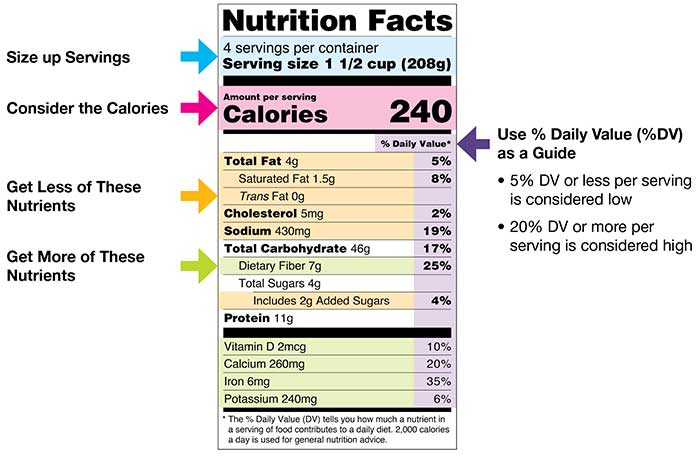
Read the Nutrition Facts label.
Understanding the Nutrition Facts label on food packages can help you make healthy choices.
First, look at the serving size and the number of servings per package — there may be more than 1 serving!
Then check out the calories. Calories tell you how much energy is in 1 serving of a food.
To stay at a healthy weight, you need to balance the calories you eat and drink with the calories you use. Use this tool to find out how many calories you need each day.
Next, look at the percent Daily Value (% DV) column. The DV shows you if a food is higher or lower in certain nutrients. Look for foods that are:
- Low in added sugars, sodium, and saturated fat (5% DV or less)
- High in fiber, calcium, potassium, iron, and vitamin D (20% DV or more)
You can also use the DV to compare the amount of calories and nutrients in different foods. Just be sure to check and see if the serving size is the same.
The picture below shows an example of a Nutrition Facts label.
To learn more about the Nutrition Facts label, check out:
Healthy Families
Be a healthy family.
Parents and caregivers are important role models for healthy eating. You can teach kids how to choose and prepare healthy snacks and meals.
- While shopping, stick to the list and choose healthier ingredients for the meals you will prepare at home. Take your child with you to the store and explain the choices you make.
- Turn cooking into a fun activity for the whole family — try out these kid-friendly recipes together.
- Check out these quick tips for making healthy snacks.
If you have a family member who has a hard time eating healthy, use these tips to start a conversation about how you can help.
Eating Out
Eat healthy away from home.
You can make smart food choices wherever you are — at work, in your favorite restaurant, or out running errands. Try these tips for eating healthy even when you're away from home:
- Pack healthy snacks like fruit, unsalted nuts, or string cheese sticks
- Look for calorie information on restaurant menus
- Choose dishes that are steamed, baked, or grilled instead of fried
- Ask to have no salt added to your meal
Get more tips for eating healthy when dining out and getting takeout [PDF - 455 KB].
See Your Doctor
If you're worried about your eating habits, talk to a doctor.
If you need help making healthier food choices, ask your doctor for help. Your doctor may refer you to a registered dietitian. A registered dietitian is a health professional who helps people with healthy eating.
What about cost?
Under the Affordable Care Act, insurance plans must cover diet counseling for people with risk factors for heart disease, like high blood pressure. Depending on your insurance plan, you may be able to get diet counseling at no cost to you. Check with your insurance company to find out more.
Medicare may also cover diet counseling at no cost. Use this tool to see what Medicare covers.
If you don't have insurance, you may still be able to get free or low-cost help. Find a health center near you and ask about diet counseling.
To learn more, check out these resources:
- Free preventive care for adults covered by the Affordable Care Act
- How the Affordable Care Act protects you
- Understanding your health insurance and how to use it [PDF - 636 KB]
Manage your high blood pressure or diabetes.
If you or a loved one has high blood pressure, type 2 diabetes, or heart disease, talk with your doctor or a registered dietitian about how to stay healthy. If you need to follow a special diet, check out these websites:
Reviewer Information
This information on healthy eating was adapted from materials from the Dietary Guidelines for Americans, the Centers for Disease Control and Prevention, the Food and Drug Administration, and the Department of Agriculture.
Reviewed by:
Dennis Anderson-Villaluz, MBA, RD, LDN, FAND
Lieutenant Commander, U.S. Public Health Service
Nutrition Advisor, Division of Prevention Science
Office of Disease Prevent and Health Promotion
You may also be interested in:


Content last updated on July 10, 2026
